

A Common Symptom of Side Loading: Asymmetric Seal Wear
When tearing down a hydraulic cylinder, finding severe wear on one side of a seal and minimal wear on the other is a classic red flag. However, as sealing engineers, we never recommend immediately blaming the seal itself.
First, we must inspect the wear status of the guide rings (wear rings), the running surfaces of the piston rod or cylinder bore, the concentricity of the assembly, and the associated clearance gaps. By combining these observations with operating pressure, temperature, stroke speed, and the extrusion gap, we can accurately diagnose whether the system is suffering from side loading, localized uneven contact, or extrusion risks.
Why Does Side Loading Occur in Hydraulic Cylinders?
The ideal operating condition for a hydraulic cylinder is perfect concentricity between the piston, piston rod, and cylinder bore, with the load transmitted strictly along the cylinder's design axis.
In real-world applications, however, equipment structural design, mounting tolerances, external load dynamics, and long-term mechanical wear inevitably force the piston or rod to deviate from this ideal axis. This manifests as side loading, radial misalignment, or dynamic eccentricity during the stroke.
Side loading doesn't just cause asymmetric seal wear and extrusion damage. It can completely fracture guide bands, leading to direct metal-to-metal contact (galling or scoring) between the piston and the bore, or the rod and the gland, drastically increasing maintenance costs and downtime.
For heavy-duty equipment like construction machinery, mining rigs, injection molding machines, and forging presses, side loading doesn't necessarily indicate a severe manufacturing defect in the cylinder; it is often a byproduct of the entire mechanical system's actual operating conditions.

1. External Loads and Mounting Structures
When the external load applied to the cylinder does not perfectly align with the piston rod axis, the rod absorbs both axial thrust and additional lateral forces or bending moments. For example, the load direction on construction machinery changes continuously during operation. Misalignment in articulation points, mounting brackets, or linkages forces the rod off its ideal trajectory.
2. Guide Ring Wear Increasing Radial Clearance
The primary function of guide rings (bearing rings) is to guide the moving components and absorb radial loads, preventing metal-to-metal contact.Seals are designed to retain fluid, not to bear radial loads. All radial forces must be absorbed by the guide elements (e.g., Phenolic resin, Glass-filled POM, or Glass-filled Nylon wear rings).
If inferior guide rings are used—or if their material and dimensions mismatch the application—they will suffer from compressive wear or creep. As the clearance gap widens, the rod or piston shifts radially, creating a wedge-shaped gap in the seal housing: heavily compressed on one side, and pulled away on the other. If you only replace the seal without addressing the worn guide rings and clearance gaps, premature seal failure is inevitable.
3. Manufacturing and Assembly Tolerances
Machining accuracy, assembly concentricity, seal groove dimensions, and installation quality directly impact the seal's operating state. Eccentricity between the rod and the gland, non-concentric grooves, or localized damage during installation can cause uneven circumferential loading on the seal lip.
4. Rod Deflection and Long-Term Structural Changes
Under heavy side loads, extended stroke lengths, or poor support structures, the piston rod can bend. In long-stroke, horizontally mounted cylinders, the sheer weight of the rod causes a natural "sag" (deflection). Over time, wear in connection pins and clevis mounts exacerbates these initial minor deviations.
The Qingdao Carlock Solution: Custom Machined Seals
In many heavy-duty applications, side loading is practically unavoidable. While the ultimate fix is always mechanical realignment and replacing worn guide rings, adjusting the mechanical structure often involves unacceptable downtime or prohibitive costs. Once the mechanical and bearing systems are deemed functional, optimizing the sealing profile becomes the most pragmatic solution.
Solving seal failure requires an accurate diagnosis—not just blindly swapping the old seal for a harder material.
Compared to standardized molded seals, CNC turned (machined) seals allow us to flexibly adjust the seal's geometry and local profile without the need for expensive, custom molds. This provides incredible flexibility for small-batch, non-standard dimensions, and specific heavy-duty applications.
Our goal at Qingdao Carlock Sealing Tech is not just to supply a replacement part, but to engineer a superior sealing system based on your specific failure modes:
Flexible Design for Eccentric Loads: When standard profiles fail, our turning process allows for immediate geometry adjustments. For low-pressure tracking issues, we might utilize an energized U-cup (a U-ring with an elastomeric O-ring energizer). For stability issues or tilting in the groove, we can engineer reinforced seal heels to combat extrusion.
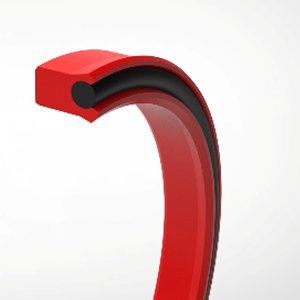
Premium Polyurethane Selection: We utilize premium Polyurethane (PU) billets suitable for precision machining, including high-performance Shore A 95 and 97 grades. However, we don't just rely on hardness to fight extrusion; we holistically evaluate the seal profile, system pressure, extrusion gaps, and the integration of active back-up rings (anti-extrusion rings).
Failure Analysis as a Starting Point: A damaged seal tells a story. Asymmetric wear points to side loading; nibbling or extrusion points to excessive clearance gaps and pressure spikes; lip deformation requires an analysis of material resilience and operating temperatures.
By analyzing your worn samples, original drawings, hardware dimensions, and operating parameters, Qingdao Carlock Sealing Tech helps clients narrow down the root cause of the failure, eliminating repetitive trial-and-error, and delivering a targeted, custom-machined sealing solution.
